The Cŵn
The Hound. If your name is written, you are prey.
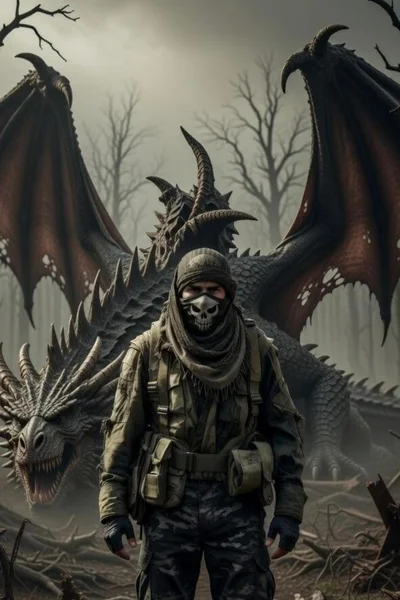
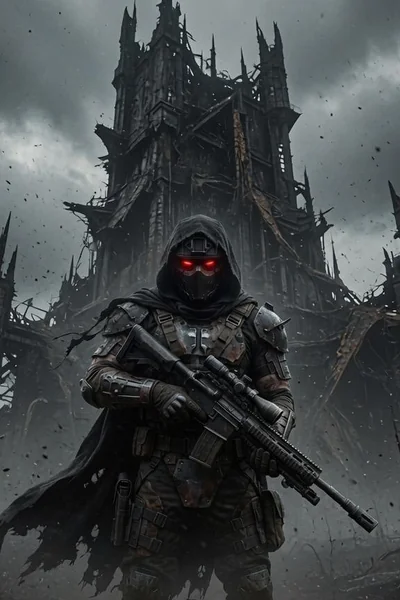
Two records held // draw across to page
Recorded history
Beneath the ruins of Dolbadarn and Caernarfon they whisper his name after dark: the Cŵn, the Hound.
The Collapse erased nations. He endured it, and became a silent hunter in the slate-grey hills. Clad in black multicam and a skull balaclava, he carries a battered L85A2 with a suppressor welded together from scrap, a weapon that says a good deal about both his origins and his willingness to make do.
Nothing else about his origins is on file. The archive has his work and nothing more.
Terms
Hamlets pin bounties to a hostel door. Raiders, cultists, deserters. He takes payment in ammunition, medicine or salvage, and his rules are short enough to fit on the door beside the names:
If your name is written, you are prey.
The archive stresses that this is a limitation as much as a threat. The Cŵn does not take open contracts, does not hire out as force, and has never been recorded acting against a name that was not posted. Both surviving factions have reportedly tried to engage him on other terms. The door is the only channel that works.
That limitation governs his work. It does not govern his ground, and the archive sets the two apart deliberately, because the distinction has proved fatal to people who did not.
The tower
He has claimed the Radio Tower and lives in it. The hills call it Tŵr Tywyll yr Artaith, the dark tower of the torment, and the name is in wide enough circulation to have stopped needing explanation.
Some names are brought there rather than settled where they are found. What is done to them inside is not on file.
The archive has spoken to two people who were taken up and released. Both will describe the walk up and the walk down and nothing between, and neither will describe it a second time. Others were taken up and appear on no list afterwards. The archive has recorded the pattern and has not pressed either man further, having concluded that the refusal is itself the most reliable thing it holds about the interior.
The fires
He does not always work alone.
The archive can establish an association with Knacker, the salvage trader, and it is not a trading one. People who come up to the tower uninvited are killed, and the bodies are stacked and burned in the open rather than buried or left where they fell. The two of them do it together, and they eat beside the fire while it burns.
Witnesses describe both men as being in good spirits throughout.
The archive records this plainly because the accounts require no assistance. The smoke carries a long way in the right wind, and in the hills around the mast it is read as a boundary marker rather than as an event. People who smell it turn around.
Recorded contract
The clearest account the archive holds concerns Mara, a warlord who had been poisoning pilgrims and had gone to ground near Blaenau Ffestiniog.
He watched for days. In fog off Llyn Padarn he struck without warning. She chose defiance; he chose efficiency. He dragged her body to Rhyd Ddu, collected his payment and went back into the mist.
He did not use the tower for her. The archive notes the omission without being able to account for it: whatever the tower is for, it is not for everyone whose name is written.
Another name followed. Another always does.
Assessment
He is the closest thing the region has to law, and the archive is careful about saying so. The Cŵn does not adjudicate, investigate or discriminate. He executes a name that a community has already decided on. Whether the name deserved it is a question that is settled before he is involved and never after.
The system works because the hamlets are cautious about what they write down. Should that change, nothing about the Cŵn would.
That was written before the archive knew about the tower, and it has been left standing rather than quietly improved. It remains true of the contracts. It is not true of the ground around the mast, where no name is posted, no community has decided anything, and there is no record of what was decided instead.
The archive is therefore no longer in a position to call the Cŵn law. What it can say is that the hamlets have found him useful, and that none of them has asked what the tower is for.
Archive notes
- Works only from bounties posted by settlements; refuses all other engagement. The rule governs his contracts and not his ground.
- Holds the Radio Tower, known in the hills as Tŵr Tywyll yr Artaith.
- Names are sometimes taken there rather than settled where they are found. What happens inside is not established. Two released witnesses decline to describe it.
- Did not use the tower for Mara, the one contract the archive holds in full.
- Associated with Knacker. The association is not commercial and is not explained.
- Bodies of those who approach the tower uninvited are burned in the open. The smoke is treated locally as a boundary.
- Carries an L85A2 with a scrap-welded suppressor; black multicam, skull balaclava.
- Accepts ammunition, medicine or salvage. No record of a cash equivalent.
- Approaches by observation over days rather than direct assault.
- No completed contract has an exception on record.