Pump Station Nine
Somebody's got to keep the clean water on.
Recorded history
The Water Works is the most valuable ground in the region. Pump Station Nine is the part of it that actually does the work.
It is not much to look at: a brick shed on the flooded edge of town, a leaking roof, a valve that whines when the pressure is wrong. The plant predates the Fall by a long way and was never modern even then. What it has, and has always had, is somebody in it.
Almost everything the archive knows about the place comes from two objects: a photograph, and a song. Both are old. The song is old enough that the archive cannot say with any confidence which world it was written in.
That matters more than it first appears. The ballad speaks of a supervisor twelve years dead whose rota was never revised, but the twelve years are counted from the singer's night shift, not from ours. Whoever that supervisor was, they died twelve years before somebody who has themselves been gone long enough for the song to have outlived every name in it. The archive has no means of fixing either date.
What can be said is that the station is still working, and that somebody is still doing the work.
The crew of 1989
The song describes a photograph hanging above the desk. The archive holds it.
Nine men in wet overalls outside the station door, hair flattened by rain, the sign reading PUMP STATION 9 on the brick behind them. Somebody has written Crew — 1989 along the bottom in pen.
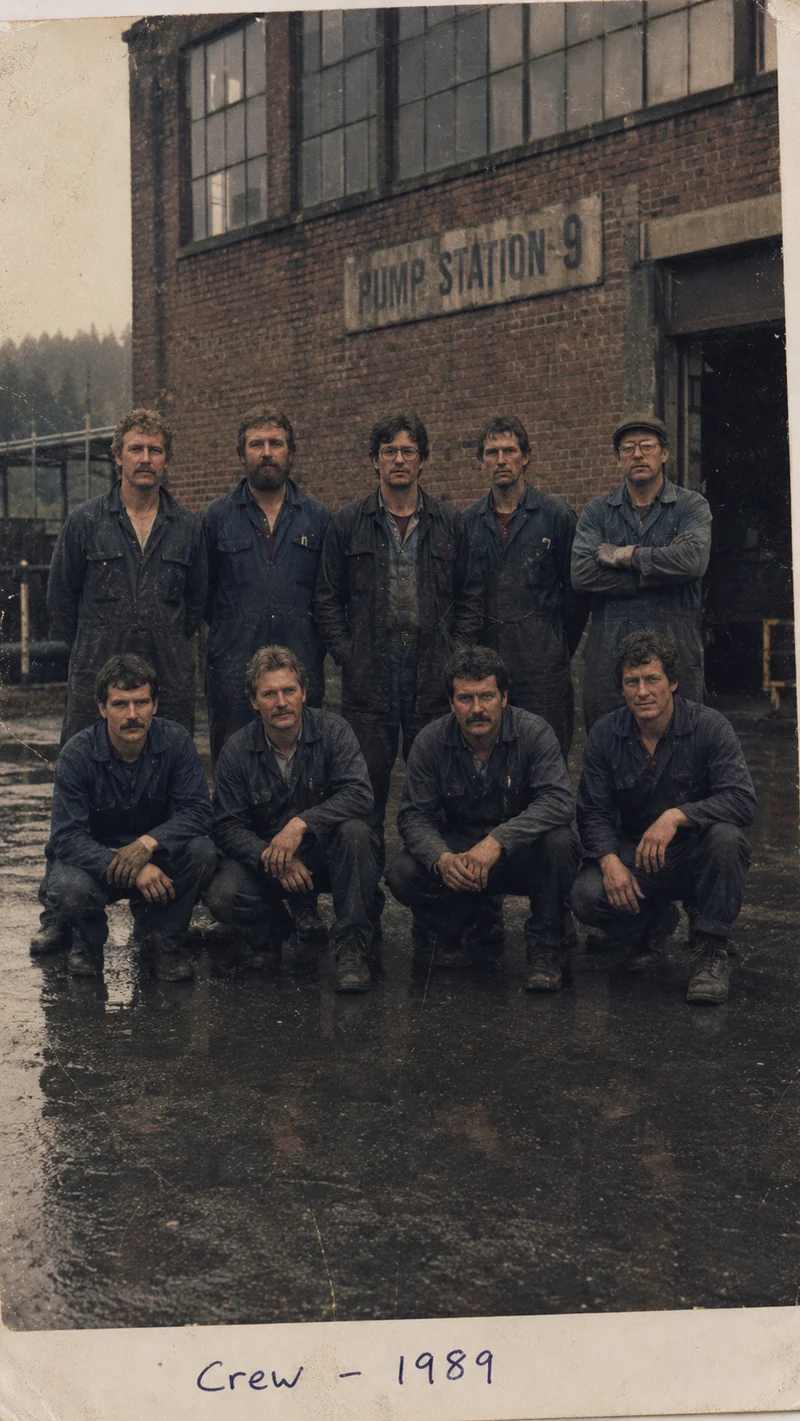
Half are gone and half moved east, says the song, which accounts for more than the nine men in the frame. The archive records the phrasing as it was given.
They were dead before the Fall. They were dead before the singer, in all likelihood, and the singer has been dead a long time. The photograph is older than the war, older than the factions, older than the archive that now holds it, and it has outlasted every institution that might have had a claim on it.
It was never preserved or protected. Nobody took it down.
The flood
The one incident the song recounts at length is the night the river climbed the wall. Like everything else in it, the archive cannot date the event and cannot corroborate it from any other source.
The intake choked with trees, the pressure needle dropped into the red and the plant went to its knees. The duty engineer fought the wheel until his palms split, kicked the starter twice, and got Turbine Two shuddering, then called the town on the service set to say that Station Nine might not hold.
What the song does next is the reason it survived at all. Boots in the tunnel. Lanterns in the cold. The medic arrived with bandaged hands, the baker brought a chain, the guards came with crowbars and the schoolchildren cleared the drain. Every shoulder found the lever, and the whole town pushed together in the dark.
The station held.
The archive notes that no faction appears anywhere in the account. Given how old the song appears to be, it is entirely possible that none of them existed yet.
The Station Nine song
The following is transcribed from a ballad still sung in the region.
It carries no date and the archive has been unable to fix one. Its internal details are of no help: the supervisor is twelve years dead, the crew photograph is from '89, the singer is waiting on a spring that has long since come and gone. All of those are measured from a night that is not this night, in a town whose name the song never gives.
What the archive can say is that the song is older than every institution described anywhere else in this collection, and that people who have never seen a working turbine still know the words.
It has since been collected. The ballad appears fourth in Songs for the Long Repair, a gathering of wasteland working songs assembled under Dr. Borschtovsky's name. That settles nothing about when it was written. It establishes only that it travelled far enough for somebody to find it worth writing down.
Clock strikes seven at the waterworks, Rain comes hammering down. I pull my boots through the flooded yard On the midnight edge of town.
The roof leaks over Turbine Three, The north valve whines in time. The supervisor's been dead twelve years, But his rota still says I'm on nights.
There's a photograph above the desk Of the crew from '89. Half are gone and half moved east — I'm still at Pump Station Nine.
I've got a wrench in my right hand, A coffee gone stone-cold, And a pressure gauge that trembles Like it knows how bad things go.
At Pump Station Nine, where the old wheels turn, We hold the pressure steady while the warning lamps burn. I've sworn a hundred winters I'll be gone by morning sun — But somebody's got to keep the clean water on.
Every spring I pack a canvas bag And leave it by the door. Say I'm taking the eastern road And I won't come back no more.
I'll find a place with open fields, Where the concrete doesn't sweat, Where a man can sleep past sunrise And his socks stay mostly dry.
Then the clinic sends a message: "Pressure's falling on the line." So I put the canvas bag away And walk to Pump Station Nine.
Because the baker needs the morning flow, The bathhouse needs it warm, And there are children filling bottles Before the next dust storm.
At Pump Station Nine, hear the old mains ring, Every kitchen, every garden drinks from everything we bring. You can hate the hill above you, you can hate what you've become — But somebody's got to keep the clean water on.
Then one night the river climbed the wall And the intake choked with trees. The pressure needle dropped to red, The whole plant hit its knees.
I fought the wheel till my palms split open, Kicked the starter twice. Turbine Two began to shudder Like a dog beneath the ice.
I called the town on the service set: "Station Nine may not hold." Then I heard boots in the tunnel And saw lanterns in the cold.
The medic came with bandaged hands. The baker brought a chain. The guards arrived with crowbars, The schoolkids cleared the drain.
Every shoulder found the lever. Every hand took hold in line. And the whole town pushed together In the dark at Station Nine.
At Pump Station Nine, let the old wheels turn! Hold the pressure steady while the warning lamps burn! No one talked of leaving when the river took the sun — We were all there keeping the clean water on.
A town is more than rooftops. A road is more than stone. A pipe is more than metal When it carries something home.
Water in the morning. Steam against the glass. A cup held to a fever. Green shoots breaking through the ash.
Maybe I will leave here. Maybe not this spring. But a place is worth believing in While broken engines sing.
At Pump Station Nine, let the valley hear: There'll be water in the morning, there'll be gardens here next year. We may never leave this town, but that doesn't mean we're done — While the water keeps on moving, there's a future yet to come.
Assessment
The archive files this record with some awkwardness.
Almost everything else in this collection concerns who holds a thing and what they extract from it. Pump Station Nine is held by nobody. It is worked, and it has apparently been worked without interruption through the collapse of the grid, the burning of the sky, the rise and destruction of three factions and the occupation of Iron Haven, none of which appear anywhere in the song, because the song is older than all of them.
That is the fact the archive finds difficult. This region has been fought over continuously for as long as anyone can document. Somewhere inside all of it, a valve was being turned on a schedule, by people who were not fighting, for a town that needed water in the morning.
That is not a strategic assessment and the archive is aware of it. The strategic assessment is on the Water Works record, where it belongs.
This one is kept because the song is still sung, and because the water is still on.
Archive notes
- Maintains line pressure for the town mains. The Water Works depends on it.
- Crew photograph, 1989, held by the archive. Provenance predates the war.
- Flood incident recounted in the song. No faction appears anywhere in it.
- The supervisor "twelve years dead" is twelve years dead at the time of the song, which is not this time.
- The Station Nine song is undated and may predate the Fall. It has outlived everyone named in it and is still sung.