RENED
A department that did not exist, still asking what happened to the country it did not exist in.
Recorded history
Nobody agrees what RENED was before the bombs. The Department's own account offers a reason for that: almost nobody was supposed to know it existed.
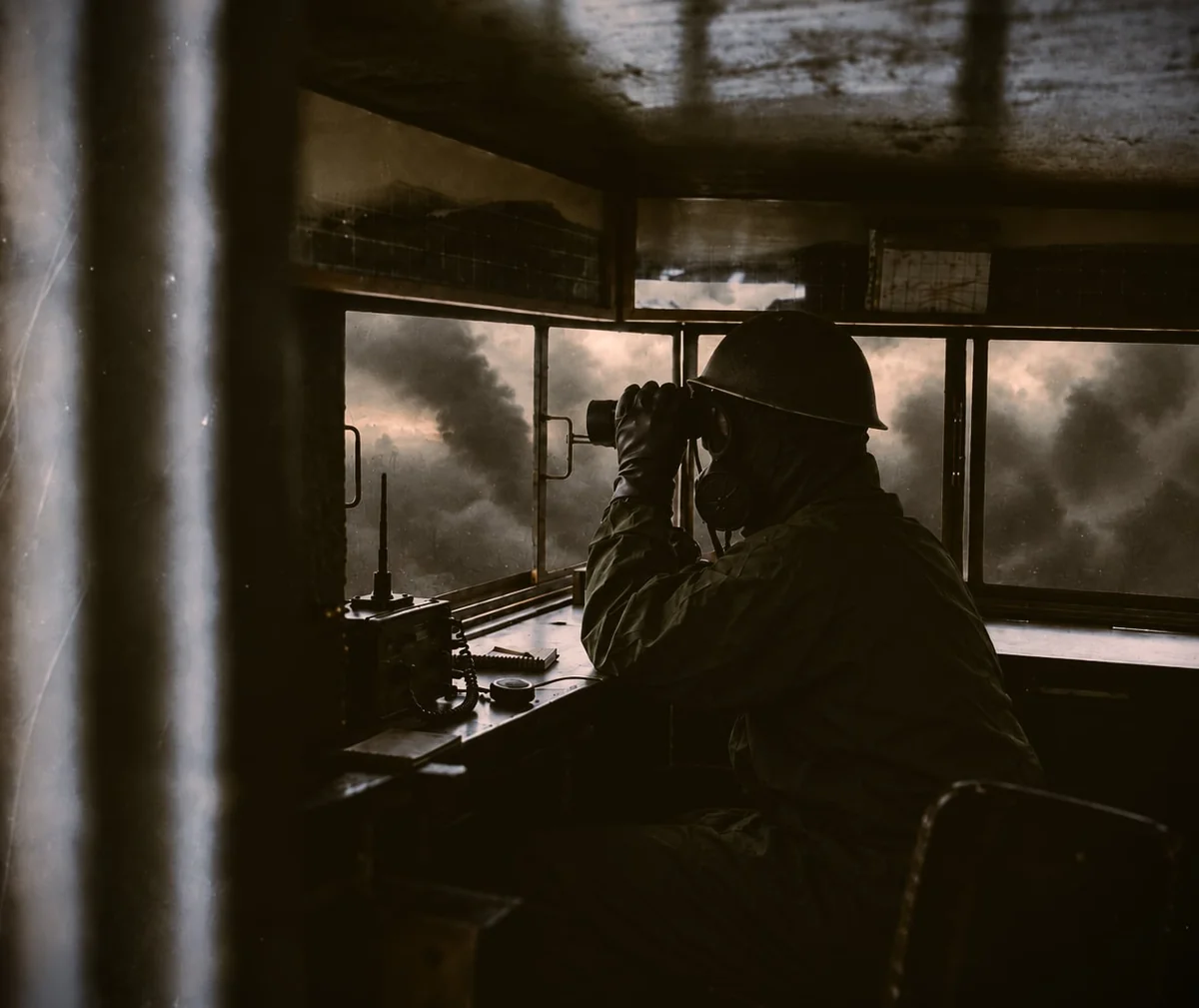
That account is what the archive holds, and it cannot be checked. As given, the Royal Electrical & Nuclear Experimental Department was a compartmented Crown body known to the Queen, the Prime Minister and a small circle of ministers, generals, admirals, intelligence officers, scientists and engineers. Even inside Whitehall and the Armed Forces it sat behind cover committees, false project names and restricted budgets. Officially, it did not exist.
The archive notes that a department which officially did not exist would have left exactly the record this one has left, which is none. So would a department that never existed at all. It has no means of telling the two apart.
Its work, in the same account, was whatever was too dangerous or too uncertain for an ordinary department: nuclear accidents, unusual radiation effects, experimental weapons, Soviet scientific programmes, emergency continuity, and what the account calls phenomena that did not fit accepted explanation.
The war
RENED has its own telling of the war that ended the old world: a Soviet invasion of Britain, the Grey War in the mountains of north Wales, and a few weeks' silence before the bombs. It agrees with the account the archive already held, and is filed with it, under the Battle for Tan y Bwlch. The archive does not make much of the agreement. The men that account is sourced to are the men the Department is reported to employ.
What the Department noticed
During the invasion and after it, according to the account, strange incidents began to accumulate. Reports contradicted each other. Dates were impossible. Equipment turned up whose provenance could not be settled, and people turned up whose memories did not fit anyone else's history. RENED took an interest and was kept busy the length of the country. Nobody in the Department understood what was happening.
The list is close to one the archive keeps itself. It records the resemblance and does not suppose it knows what it amounts to.
Then, in the account, the bombs fell.
Slippy Time
This is the point at which the Department's account stops being history and becomes theory. The archive is particularly careful with it.
Some surviving RENED personnel remember nuclear war destroying what was left of their world. They do not claim that was the end of it. They speak instead of a theory, and they speak of it as settled: that the Wasteland contains people, objects, records and memories from histories that cannot all be true together, sharing one local present. It is commonly called Slippy Time, by the Department's people at least. As they describe it there is no portal, no flash and no journey. From the inside one moment simply follows another, until a person finds that the world around them no longer shares their yesterday.
One RENED account goes further. It claims that fragments of the British state were caught in the same way: government personnel, the Department's own staff, records, equipment and elements of the British Army, turning up in the Wasteland at different times and under different circumstances. The mechanism, it concedes, is unknown. The theory is said to treat the collapse of a civilisation as a condition that may leave its history unusually open to what is called causal refraction, and to stop short of treating it as proof of a single apocalypse shared by everyone.
Where the theory came from is less clear than the confidence with which it is repeated. The account refers only to "later scientific work", and does not say whose. Some of the Department's people talk as though the work were RENED's own; the account itself never quite claims it. The archive has seen none of that work, and cannot establish who did it, when, or whether those who did it held the conclusions as firmly as the people now repeating them.
The archive files the theory as one RENED holds, not one RENED can be shown to have produced, and does not adopt it. It is not in a position to test any part of it. It notes that a phenomenon with a name and a vocabulary has not thereby been explained, and that nobody on file claims to have explained it.
Caernarfon
In north Wales, the account says, surviving RENED and British Army personnel drifted towards Caernarfon, where an abandoned Territorial Army centre, the Militia Barracks, had become a point of contact for surviving soldiers and for whatever remained of pre-Fall authority. At some point the Department itself arrived there. The archive cannot say when, from where, or how much of it came.
Since then it is said to have taken on the two Old Soldiers, who were at the barracks before it, as Field Surveyors, sent out on survey and recovery work beyond the wire. What the barracks can put on the road is recorded on the barracks' own record, and most of it is rumour.
Whether RENED truly understands what happened is doubted even by the account that describes it. It has simply decided that somebody ought to keep investigating what happened to their island. The archive has some sympathy with the position.
Filed with the account
Archive notes
- Every source is internal. Everything on file about RENED comes from its own people or from people it employs.
- Name given as the Royal Electrical & Nuclear Experimental Department. No document establishing it before the Fall has reached the archive.
- Tells the same war as the Battle for Tan y Bwlch, and its telling is filed there. Not counted as corroboration; see above.
- Places strange incidents during the invasion itself, before the bombs.
- Repeats, as settled, a theory of what it calls Slippy Time. The theory's origin is not established: the Department's people speak of it as theirs, and their own account does not claim it. The archive does not adopt it and has no means of testing it.
- Reported at the Militia Barracks, Caernarfon.
- The Old Soldiers are reportedly attached as Field Surveyors.
- Doubted, by its own account, to understand what happened.